YAML Ain’t Markup Language (YAML™)
Version 1.1
Final Draft -- 2005-01-18
Copyright © 2001-2008 Oren Ben-Kiki, Clark Evans, Ingy döt Net
This document may be freely copied, provided it is not modified.
Status of this Document
This specification is a draft reflecting consensus reached by members of
the yaml-core
mailing list. Any questions regarding this draft should be
raised on this list. We expect all further changes to be strictly
limited to wording corrections and fixing production bugs.
We wish to thank implementers, who have tirelessly tracked earlier
versions of this specification, as well as our fabulous user community
whose feedback has both validated and clarified our direction.
Abstract
YAML™ (rhymes with “camel”) is a
human-friendly, cross language, Unicode based data serialization
language designed around the common native data structures of agile
programming languages. It is broadly useful for programming needs
ranging from configuration files to Internet messaging to object
persistence to data auditing. Together with the Unicode standard for characters,
this specification provides all the information necessary to understand
YAML Version 1.1 and to create programs that process YAML information.
“YAML Ain’t Markup Language” (abbreviated YAML) is a data
serialization language designed to be human-friendly and work well with
modern programming languages for common everyday tasks. This
specification is both an introduction to the YAML language and the
concepts supporting it; it is also a complete reference of the
information needed to develop applications for processing YAML.
Open, interoperable and readily understandable tools have advanced
computing immensely. YAML was designed from the start to be useful and
friendly to people working with data. It uses Unicode printable characters, some of
which provide structural information and the rest containing the data
itself. YAML achieves a unique cleanness by minimizing the amount of
structural characters and allowing the data to show itself in a natural
and meaningful way. For example, indentation may be used for structure, colons separate
“mapping
key: value” pairs, and dashes are used to create
“bullet” lists.
There are myriad flavors of data structures, but they can all be
adequately represented with three
basic primitives: mappings (hashes/dictionaries), sequences
(arrays/lists) and scalars (strings/numbers). YAML leverages these
primitives and adds a simple typing system and aliasing mechanism to form a
complete language for serializing any data structure. While most
programming languages can use YAML for data serialization, YAML excels in
working with those languages that are fundamentally built around the
three basic primitives. These include the new wave of agile languages
such as Perl, Python, PHP, Ruby, and Javascript.
There are hundreds of different languages for programming, but only a
handful of languages for storing and transferring data. Even though its
potential is virtually boundless, YAML was specifically created to work
well for common use cases such as: configuration files, log files,
interprocess messaging, cross-language data sharing, object persistence,
and debugging of complex data structures. When data is easy to view and
understand, programming becomes a simpler task.
The design goals for YAML are:
-
YAML is easily readable by humans.
-
YAML matches the native data structures of agile languages.
-
YAML data is portable between programming languages.
-
YAML has a consistent model to support generic tools.
-
YAML supports one-pass processing.
-
YAML is expressive and extensible.
-
YAML is easy to implement and use.
YAML’s initial direction was set by the data serialization and
markup language discussions among SML-DEV members. Later
on, it directly incorporated experience from Brian Ingerson’s Perl
module Data::Denter. Since then, YAML has matured through ideas and
support from its user community.
YAML integrates and builds upon concepts described by C, Java, Perl, Python, Ruby, RFC0822 (MAIL),
RFC1866
(HTML), RFC2045 (MIME),
RFC2396 (URI),
XML, SAX and SOAP.
The syntax of YAML was motivated by Internet Mail (RFC0822) and remains
partially compatible with that standard. Further, borrowing from MIME
(RFC2045), YAML’s top-level production is a stream of
independent documents; ideal for message-based distributed
processing systems.
YAML’s indentation-based scoping is similar to Python’s
(without the ambiguities caused by tabs). Indented blocks facilitate easy
inspection of the data’s structure. YAML’s literal
style leverages this by enabling formatted text to be cleanly
mixed within an indented
structure without troublesome escaping. YAML also allows the use of
traditional indicator-based
scoping similar to Perl’s. Such flow content can be freely
nested inside indented blocks.
YAML’s double-quoted style uses familiar C-style escape sequences.
This enables ASCII encoding of non-printable or 8-bit (ISO 8859-1) characters such as
“\x3B”. Non-printable 16-bit Unicode and
32-bit (ISO/IEC 10646) characters are supported with escape sequences
such as “\u003B”
and “\U0000003B”.
Motivated by HTML’s end-of-line normalization, YAML’s line folding employs an intuitive
method of handling line
breaks. A single line
break is folded
into a single space, while empty
lines are interpreted as line break characters. This technique allows for
paragraphs to be word-wrapped without affecting the canonical form of the content.
YAML’s core type system is based on the requirements of agile
languages such as Perl, Python, and Ruby. YAML directly supports both
collection (mapping, sequence)
and scalar
content. Support for common types enables programmers to use
their language’s native data structures for YAML manipulation,
instead of requiring a special document object model (DOM).
Like XML’s SOAP, YAML supports serializing native graph data structures
through an aliasing mechanism. Also like SOAP, YAML provides for
application-defined types. This
allows YAML to represent rich
data structures required for modern distributed computing. YAML
provides globally unique type
names using a namespace mechanism inspired by Java’s
DNS-based package naming convention and XML’s URI-based namespaces.
YAML was designed to support incremental interfaces that include both
input (“getNextEvent()”) and output
“sendNextEvent()”) one-pass interfaces. Together, these
enable YAML to support the processing of large documents
(e.g. transaction logs) or continuous streams (e.g. feeds from a
production machine).
Newcomers to YAML often search for its correlation to the eXtensible
Markup Language (XML). Although the two languages may actually compete
in several application domains, there is no direct correlation between
them.
YAML is primarily a data serialization language. XML was designed to be
backwards compatible with the Standard Generalized Markup Language
(SGML) and thus had many design constraints placed on it that YAML does
not share. Inheriting SGML’s legacy, XML is designed to support
structured documentation, where YAML is more closely targeted at data
structures and messaging. Where XML is a pioneer in many domains, YAML
is the result of lessons learned from XML and other technologies.
It should be mentioned that there are ongoing efforts to define
standard XML/YAML mappings. This generally requires that a subset of
each language be used. For more information on using both XML and YAML,
please visit https://yaml.org/xml/index.html.
This specification uses key words based on RFC2119 to indicate
requirement level. In particular, the following words are used to
describe the actions of a YAML processor:
-
May
-
The word may, or the adjective
optional, mean that
conforming YAML processors
are permitted, but need not
behave as described.
-
Should
-
The word should, or the
adjective recommended,
mean that there could be reasons for a YAML processor to deviate from the
behavior described, but that such deviation could hurt
interoperability and should therefore be advertised with
appropriate notice.
-
Must
-
The word must, or the term
required or shall, mean that the behavior described
is an absolute requirement of the specification.
This section provides a quick glimpse into the expressive power of YAML.
It is not expected that the first-time reader grok all of the examples.
Rather, these selections are used as motivation for the remainder of the
specification.
YAML’s block collections use
indentation for scope
and begin each entry on its own line. Block
sequences indicate each entry with a dash and space (
“-”). Mappings use a colon and
space (“: ”) to mark each mapping
key: value pair.
Example 2.1.
Sequence of Scalars
(ball players)
- Mark McGwire
- Sammy Sosa
- Ken Griffey
|
Example 2.2.
Mapping Scalars to Scalars
(player statistics)
hr:  65    # Home runs
avg: 0.278 # Batting average
rbi: 147   # Runs Batted In
|
Example 2.3.
Mapping Scalars to Sequences
(ball clubs in each league)
american:
  - Boston Red Sox
  - Detroit Tigers
  - New York Yankees
national:
  - New York Mets
  - Chicago Cubs
  - Atlanta Braves
|
Example 2.4.
Sequence of Mappings
(players’ statistics)
-
  name: Mark McGwire
  hr:   65
  avg:  0.278
-
  name: Sammy Sosa
  hr:   63
  avg:  0.288
|
YAML also has flow styles, using explicit indicators rather than indentation to denote scope.
The flow sequence is written as a comma separated list
within square brackets. In a similar manner, the flow
mapping uses curly braces.
Example 2.5. Sequence of Sequences - [name , hr, avg ]
- [Mark McGwire, 65, 0.278]
- [Sammy Sosa , 63, 0.288]
|
Example 2.6. Mapping of Mappings Mark McGwire: {hr: 65, avg: 0.278}
Sammy Sosa: {
hr: 63,
avg: 0.288
}
|
YAML uses three dashes (“---”) to separate documents
within a stream. Three dots ( “...”) indicate the end of
a document without starting a new one, for use in communication
channels. Comment lines begin with the Octothorpe (also called
“hash”, “sharp”, or “number
sign” - “#”).
Example 2.7.
Two Documents in a Stream
(each with a leading comment)
# Ranking of 1998 home runs
---
- Mark McGwire
- Sammy Sosa
- Ken Griffey

# Team ranking
---
- Chicago Cubs
- St Louis Cardinals
|
Example 2.8.
Play by Play Feed
from a Game
---
time: 20:03:20
player: Sammy Sosa
action: strike (miss)
...
---
time: 20:03:47
player: Sammy Sosa
action: grand slam
...
|
Repeated nodes are first identified by an anchor
(marked with the ampersand - “&”), and are then aliased
(referenced with an asterisk - “*”) thereafter.
Example 2.9.
Single Document with
Two Comments
---
hr: # 1998 hr ranking
  - Mark McGwire
  - Sammy Sosa
rbi:
  # 1998 rbi ranking
  - Sammy Sosa
  - Ken Griffey
|
Example 2.10.
Node for “Sammy Sosa”
appears twice in this document
---
hr:
  - Mark McGwire
  # Following node labeled SS
  - &SS Sammy Sosa
rbi:
  - *SS # Subsequent occurrence
  - Ken Griffey
|
A question mark and space (“? ”) indicate a complex mapping key.
Within a block collection, key: value pairs can start
immediately following the dash, colon, or question mark.
Example 2.11. Mapping between Sequences ? - Detroit Tigers
- Chicago cubs
:
- 2001-07-23
? [ New York Yankees,
Atlanta Braves ]
: [ 2001-07-02, 2001-08-12,
2001-08-14 ]
|
Example 2.12. In-Line Nested Mapping ---
# products purchased
- item : Super Hoop
quantity: 1
- item : Basketball
quantity: 4
- item : Big Shoes
quantity: 1
|
Scalar
content can be written in block form, using a literal
style (“|”) where all line breaks are significant.
Alternatively, they can be written with the folded
style (“>”) where each line break is folded to a space unless it ends an
empty or a “more indented”
line.
Example 2.13.
In literals,
newlines are preserved
# ASCII Art
--- |
  \//||\/||
  // ||  ||__
|
Example 2.14.
In the plain scalar,
newlines become spaces
---
  Mark McGwire's
  year was crippled
  by a knee injury.
|
Example 2.15.
Folded newlines are preserved
for "more indented" and blank lines
>
 Sammy Sosa completed another
 fine season with great stats.

   63 Home Runs
   0.288 Batting Average

 What a year!
|
Example 2.16.
Indentation determines scope
name: Mark McGwire
accomplishment: >
  Mark set a major league
  home run record in 1998.
stats: |
  65 Home Runs
  0.278 Batting Average
|
YAML’s flow scalars include the plain style (most
examples thus far) and quoted styles. The double-quoted style provides escape sequences.
The single-quoted style is useful when escaping is not
needed. All flow scalars can span
multiple lines; line
breaks are always folded.
Example 2.17. Quoted Scalars unicode: "Sosa did fine.\u263A"
control: "\b1998\t1999\t2000\n"
hexesc: "\x13\x10 is \r\n"
single: '"Howdy!" he cried.'
quoted: ' # not a ''comment''.'
tie-fighter: '|\-*-/|'
|
Example 2.18. Multi-line Flow Scalars plain:
This unquoted scalar
spans many lines.
quoted: "So does this
quoted scalar.\n"
|
In YAML, untagged nodes
are given an type depending on the application. The examples in this
specification generally use the “seq”,
“map” and
“str”
types from the YAML tag
repository. A few examples also use the “int” and
“float”
types. The repository includes additional types such as “null”,
“bool”,
“set” and
others.
Example 2.19. Integers canonical: 12345
decimal: +12,345
sexagesimal: 3:25:45
octal: 014
hexadecimal: 0xC
|
Example 2.20. Floating Point canonical: 1.23015e+3
exponential: 12.3015e+02
sexagesimal: 20:30.15
fixed: 1,230.15
negative infinity: -.inf
not a number: .NaN
|
Example 2.21. Miscellaneous null: ~
true: y
false: n
string: '12345'
|
Example 2.22. Timestamps canonical: 2001-12-15T02:59:43.1Z
iso8601: 2001-12-14t21:59:43.10-05:00
spaced: 2001-12-14 21:59:43.10 -5
date: 2002-12-14
|
Explicit typing is denoted with a tag using the exclamation
point (“!”) symbol. Global tags are URIs and may be
specified in a shorthand
form using a handle. Application-specific local tags may also be used.
Example 2.23. Various Explicit Tags ---
not-date: !!str 2002-04-28
picture: !!binary |
R0lGODlhDAAMAIQAAP//9/X
17unp5WZmZgAAAOfn515eXv
Pz7Y6OjuDg4J+fn5OTk6enp
56enmleECcgggoBADs=
application specific tag: !something |
The semantics of the tag
above may be different for
different documents.
|
Example 2.24. Global Tags %TAG ! tag:clarkevans.com,2002:
--- !shape
# Use the ! handle for presenting
# tag:clarkevans.com,2002:circle
- !circle
center: &ORIGIN {x: 73, y: 129}
radius: 7
- !line
start: *ORIGIN
finish: { x: 89, y: 102 }
- !label
start: *ORIGIN
color: 0xFFEEBB
text: Pretty vector drawing.
|
Example 2.25. Unordered Sets # sets are represented as a
# mapping where each key is
# associated with the empty string
--- !!set
? Mark McGwire
? Sammy Sosa
? Ken Griff
|
Example 2.26. Ordered Mappings # ordered maps are represented as
# a sequence of mappings, with
# each mapping having one key
--- !!omap
- Mark McGwire: 65
- Sammy Sosa: 63
- Ken Griffy: 58
|
Below are two full-length examples of YAML. On the left is a sample
invoice; on the right is a sample log file.
Example 2.27. Invoice --- !<tag:clarkevans.com,2002:invoice>
invoice: 34843
date : 2001-01-23
bill-to: &id001
given : Chris
family : Dumars
address:
lines: |
458 Walkman Dr.
Suite #292
city : Royal Oak
state : MI
postal : 48046
ship-to: *id001
product:
- sku : BL394D
quantity : 4
description : Basketball
price : 450.00
- sku : BL4438H
quantity : 1
description : Super Hoop
price : 2392.00
tax : 251.42
total: 4443.52
comments:
Late afternoon is best.
Backup contact is Nancy
Billsmer @ 338-4338.
|
Example 2.28. Log File ---
Time: 2001-11-23 15:01:42 -5
User: ed
Warning:
This is an error message
for the log file
---
Time: 2001-11-23 15:02:31 -5
User: ed
Warning:
A slightly different error
message.
---
Date: 2001-11-23 15:03:17 -5
User: ed
Fatal:
Unknown variable "bar"
Stack:
- file: TopClass.py
line: 23
code: |
x = MoreObject("345\n")
- file: MoreClass.py
line: 58
code: |-
foo = bar
|
Chapter 3. Processing YAML Information
YAML is both a text format and a method for presenting any data structure in this format.
Therefore, this specification defines two concepts: a class of data
objects called YAML representations, and a syntax for
presenting YAML representations as a series of
characters, called a YAML stream. A YAML processor is a tool for converting
information between these complementary views. It is assumed that a YAML
processor does its work on behalf of another module, called an application. This chapter describes the
information structures a YAML processor must provide to or obtain from
the application.
YAML information is used in two ways: for machine processing, and for
human consumption. The challenge of reconciling these two perspectives is
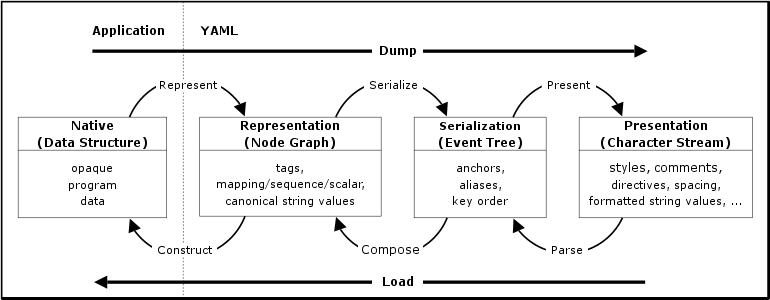
best done in three distinct translation stages: representation, serialization, and presentation. Representation addresses how YAML
views native data structures to achieve portability between programming
environments. Serialization
concerns itself with turning a YAML representation into a serial form,
that is, a form with sequential access constraints. Presentation deals with the formatting
of a YAML serialization as a
series of characters in a human-friendly manner.
A YAML processor need not expose the serialization or representation stages. It may
translate directly between native data structures and a character
stream
(dump and load in the diagram above). However, such a
direct translation should take place so that the native data structures
are constructed only from
information available in the representation.
This section details the processes shown in the diagram above. Note a
YAML processor need not provide
all these processes. For example, a YAML library may provide only YAML
input ability, for loading configuration files, or only output ability,
for sending data to other applications.
YAML represents any native
data structure using three node
kinds: sequence - an ordered series of entries; mapping -
an unordered association of unique keys to values; and
scalar - any datum with opaque structure presentable as a series of Unicode
characters. Combined, these primitives generate directed graph
structures. These primitives were chosen because they are both
powerful and familiar: the sequence corresponds to a
Perl array and a Python list, the mapping corresponds to a Perl
hash table and a Python dictionary. The scalar represents strings,
integers, dates, and other atomic data types.
Each YAML node requires, in addition to its kind and content, a tag specifying
its data type. Type specifiers are either global URIs, or are local in scope to a single application. For example, an integer
is represented in YAML with a scalar plus the global tag
“tag:yaml.org,2002:int”. Similarly, an invoice object,
particular to a given organization, could be represented as a
mapping together with the local tag “!invoice”. This simple model
can represent any data structure independent of programming language.
For sequential access mediums, such as an event callback API, a YAML
representation must be
serialized to an ordered tree.
Since in a YAML representation, mapping keys
are unordered and nodes may be referenced more than once (have more
than one incoming “arrow”), the serialization process is
required to impose an ordering
on the mapping
keys and to replace the second and subsequent references to
a given node with place holders called aliases. YAML
does not specify how these serialization details are chosen. It is up to the
YAML processor to come up with
human-friendly key order and
anchor names, possibly with the help of the application. The result of this
process, a YAML serialization
tree, can then be traversed to produce a series of event
calls for one-pass processing of YAML data.
The final output process is presenting the YAML serializations as a character
stream in a human-friendly manner. To maximize human
readability, YAML offers a rich set of stylistic options which go
far beyond the minimal functional needs of simple data storage.
Therefore the YAML processor
is required to introduce various presentation details when creating the stream, such
as the choice of node styles, how
to format content, the amount of
indentation, which
tag handles to use, the
node
tags to leave unspecified, the set of directives to provide and
possibly even what comments to add. While some of this can be done with
the help of the application, in general this process
should be guided by the preferences of the user.
This section specifies the formal details of the results of the above
processes. To maximize data portability between programming languages
and implementations, users of YAML should be mindful of the distinction
between serialization or
presentation properties and
those which are part of the YAML representation. Thus, while imposing
a order on mapping keys is
necessary for flattening YAML representations to a sequential
access medium, this serialization detail must not be used to convey
application level information.
In a similar manner, while indentation technique and a choice of a node style are needed for the human
readability, these presentation
details are neither part of the YAML serialization nor the YAML representation. By carefully
separating properties needed for serialization and presentation, YAML representations of application information will be
consistent and portable between various programming environments.
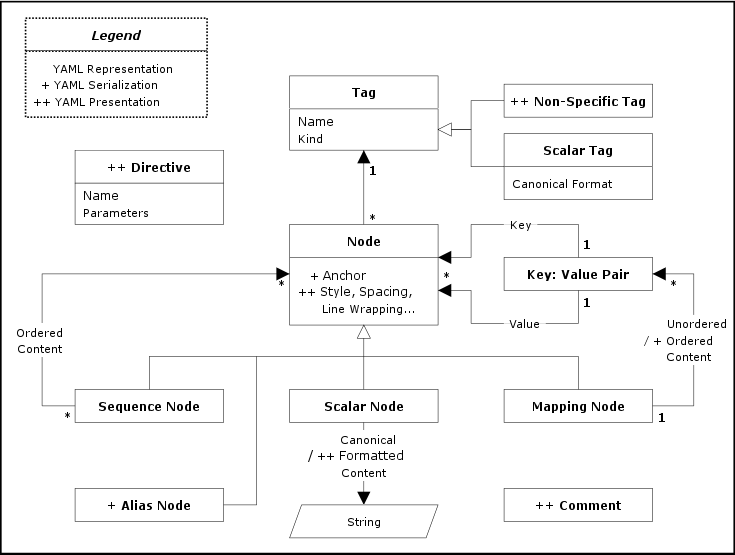
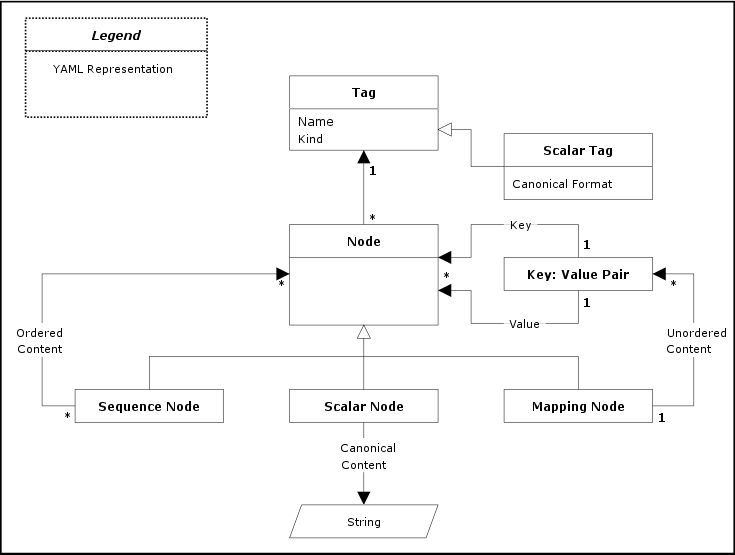
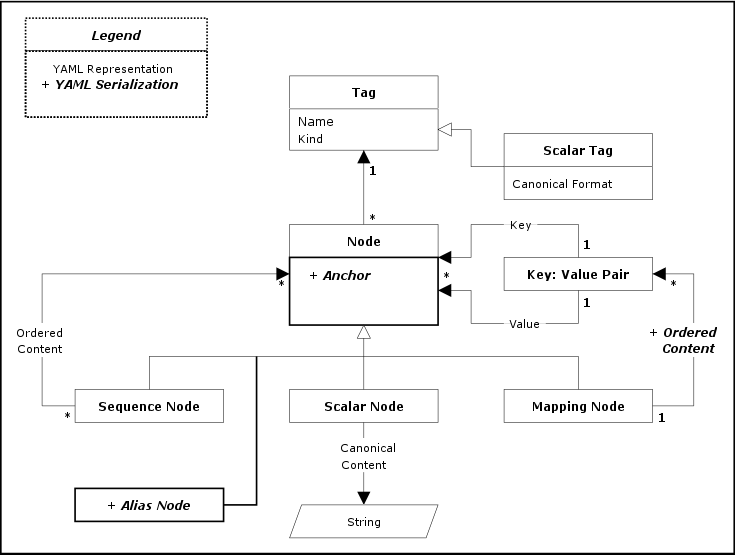
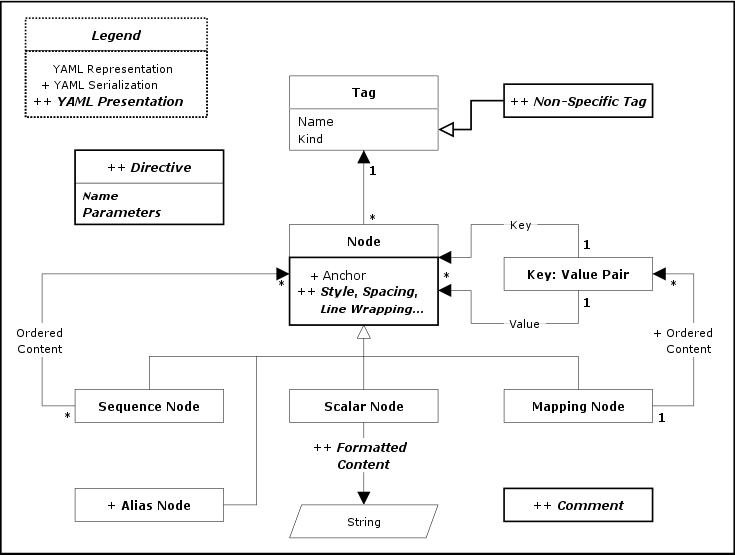
The following diagram summarizes the three information models. Full
arrows denote composition, hollow arrows denote inheritance,
“1” and “*” denote “one” and
“many” relationships. A single “+” denotes
serialization details, a
double “++” denotes presentation details.
3.2.1. Representation Graph
YAML’s representation
of native data is a rooted, connected, directed graph of tagged nodes. By
“directed graph” we mean a set of nodes and
directed edges (“arrows”), where each edge connects one
node
to another (see a formal
definition). All the nodes must be reachable from
the root node via such edges.
Note that the YAML graph may include cycles, and a node may have
more than one incoming edge.
Nodes
that are defined in terms of other nodes are collections and nodes that are independent of
any other nodes are scalars. YAML supports two
kinds of collection
nodes, sequences and mappings. Mapping
nodes are somewhat tricky because their keys are
unordered and must be unique.
YAML nodes have content of one of three
kinds: scalar, sequence, or
mapping. In addition, each node has a tag which serves to
restrict the set of possible values which the node’s content can
have.
-
Scalar
-
The content of a scalar node is an
opaque datum that can be presented as a series of zero or
more Unicode characters.
-
Sequence
-
The content of a sequence node is an
ordered series of zero or more nodes. In particular, a sequence
may contain the same node more than once or it could even
contain itself (directly or indirectly).
-
Mapping
-
The content of a mapping node is an
unordered set of key: value node pairs, with
the restriction that each of the keys is unique. YAML places no further
restrictions on the nodes. In particular, keys may be arbitrary
nodes, the same node may be used as the value of several
key: value pairs, and a mapping could even contain itself
as a key or a value (directly or indirectly).
When appropriate, it is convenient to consider sequences and
mappings together, as collections. In this view,
sequences are treated as mappings with integer keys starting at
zero. Having a unified collections view for sequences and mappings
is helpful both for creating practical YAML tools and APIs and for
theoretical analysis.
YAML represents type
information of native data structures with a simple identifier,
called a tag. Global
tags are URIs and hence
globally unique across all applications. The
“tag”: URI
scheme (mirror) is
recommended for all global YAML tags. In contrast, local tags are specific to a single
application. Local tags
start with “!”, are not URIs and are not
expected to be globally unique. YAML provides a “TAG” directive to
make tag notation less verbose; it also offers easy migration from
local to global tags. To ensure this, local tags are restricted to
the URI character set and use URI character escaping.
YAML does not mandate any special relationship between different
tags that begin with the same substring. Tags ending with URI
fragments (containing “#”) are no exception; tags that
share the same base URI but differ in their fragment part are
considered to be different, independent tags. By convention,
fragments are used to identify different “variants” of
a tag, while “/” is used to define nested tag
“namespace” hierarchies. However, this is merely a
convention, and each tag may employ its own rules. For example,
Perl tags may use “::” to express namespace
hierarchies, Java tags may use “.”, etc.
YAML tags are used to associate meta information with each node. In
particular, each tag must specify the expected node kind (scalar, sequence, or mapping). Scalar
tags must also provide mechanism for converting formatted content to a canonical form for supporting
equality testing.
Furthermore, a tag may provide additional information such as the
set of allowed content values for validation, a mechanism for
tag resolution, or any
other data that is applicable to all of the tag’s nodes.
3.2.1.3. Nodes Comparison
Since YAML mappings require key uniqueness, representations must include a
mechanism for testing the equality of nodes. This is non-trivial
since YAML allows various ways to format a given scalar content. For
example, the integer eleven can be written as “013”
(octal) or “0xB” (hexadecimal). If both forms are
used as keys in the same mapping, only a YAML
processor which recognizes
integer formats would correctly
flag the duplicate key as an error.
-
Canonical Form
-
YAML supports the need for scalar equality by
requiring that every scalartag must
specify a mechanism to producing the canonical form of any
formatted content. This
form is a Unicode character string which presents the content and can be used for equality testing.
While this requirement is stronger than a well defined equality
operator, it has other uses, such as the production of digital
signatures.
-
Equality
-
Two nodes must have the same tag and
content to be equal. Since each tag
applies to exactly one kind,
this implies that the two nodes must have the
same kind to be equal. Two
scalars are equal only when their tags and
canonical forms are equal character-by-character. Equality of
collections is defined recursively. Two
sequences are equal only when they have the
same tag and length, and each node in
one sequence is equal to the corresponding
node in the other sequence. Two mappings are equal only when they have the
same tag and an equal set of keys,
and each key in this set is associated with equal
values in both mappings.
-
Identity
-
Two nodes are identical only when they represent the same native data
structure. Typically, this corresponds to a single memory
address. Identity should not be confused with equality; two
equal nodes need not have the same identity. A YAML
processor may treat
equal scalars as if they were identical. In
contrast, the separate identity of two distinct but equal
collections must be preserved.
3.2.2. Serialization Tree
To express a YAML representation using a serial API,
it necessary to impose an order on mapping keys and employ
alias
nodes to indicate a subsequent occurrence of a previously
encountered node. The result of this process is a serialization tree, where each
node
has an ordered set of children. This tree can be traversed for a
serial event-based API. Construction of native structures from
the serial interface should not use key
order or anchors for the preservation of important data.
3.2.3. Presentation Stream
A YAML presentation is a
stream of Unicode characters making use of of
styles, formats, comments, directives and other presentation details to present a YAML serialization in a human readable
way. Although a YAML processor
may provide these details when parsing, they should not be reflected in
the resulting serialization. YAML allows several
serializations to be
contained in the same YAML character stream as a series of documents
separated by document
boundary markers. Documents appearing in the same stream
are independent; that is, a node must not appear in more
than one serialization
tree or representation
graph.
Each node is presented in some style, depending on its kind. The node style is a presentation detail and is
not reflected in the serialization
tree or representation
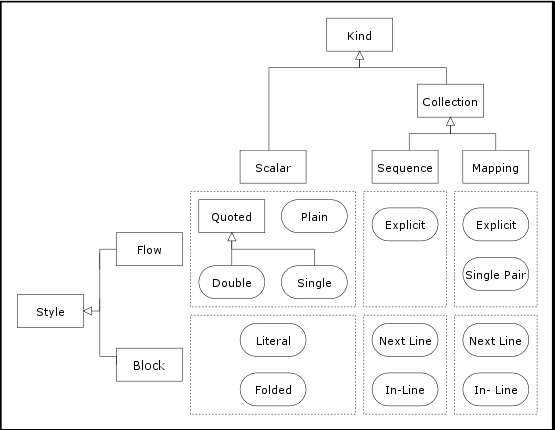
graph. There are two groups of styles, block
and flow. Block styles use indentation to denote nesting
and scope within the document. In contrast, flow
styles rely on explicit indicators to denote nesting and
scope.
YAML provides a rich set of scalar styles. Block
scalar styles include the literal style and
the folded style; flow scalar styles include
the plain style and two quoted styles, the
single-quoted style and the double-quoted style. These styles offer a range of
trade-offs between expressive power and readability.
Normally, the content of block collections
begins on the next line. In most cases, YAML also allows block
collections to start in-line for more compact
notation when nesting block sequences and
block mappings inside each other. When nesting
flow collections, a flow mapping with a
single key: value pair may be specified
directly inside a flow sequence, allowing for
a compact “ordered mapping” notation.
3.3. Loading Failure Points
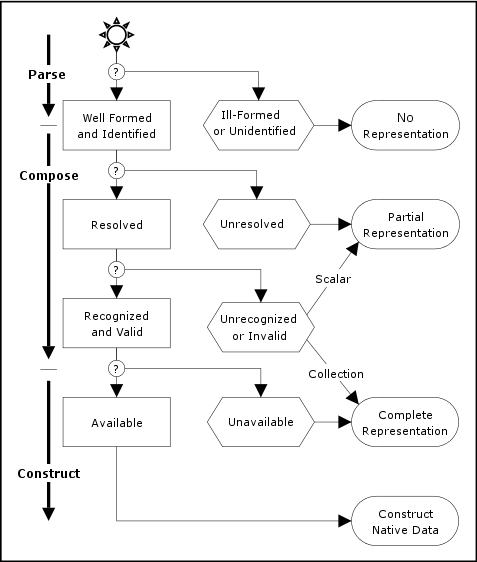
The process of loading native data
structures from a YAML stream has several potential failure points. The character stream may be
ill-formed, aliases may be
unidentified, unspecified tags may be unresolvable, tags may be unrecognized, the content may
be invalid, and a native
type may be unavailable.
Each of these failures results with an incomplete loading.
A partial
representation need not resolve the tag of each node, and the
canonical form of scalar content
need not be available. This weaker representation is useful for cases
of incomplete knowledge of the types used in the document. In
contrast, a complete
representation specifies the tag of each node, and
provides the canonical form
of scalar
content, allowing for equality testing. A complete
representation is required in order to construct native data structures.
3.3.1. Well-Formed and Identified
A well-formed
character stream must match the productions specified in the
next chapter. Successful loading also requires that each alias shall
refer to a previous node identified by the anchor. A
YAML processor should reject
ill-formed streams and
unidentified aliases.
A YAML processor may recover
from syntax errors, possibly by ignoring certain parts of the input,
but it must provide a mechanism for reporting such errors.
It is not required that all the tags of the complete representation
be explicitly specified in the character stream. During parsing, nodes that omit the tag are given a
non-specific tag:
“?”
for plain scalars and “!” for all other nodes. These
non-specific tags must be resolved to a specific tag (either a local tag or a global
tag) for a complete representation to be composed.
Resolving the tag of a node must only depend on the
following three parameters: the non-specific tag of the node, the path
leading from the root node to
the node, and the content (and hence the
kind) of the node. In
particular, resolution must not consider presentation details such as
comments, indentation and node
style. Also, resolution must not consider the content of
any other node, except for the content of the key nodes
directly along the path leading from the root node to the resolved node. In particular,
resolution must not consider the content of a sibling node in a
collection or the content of the value node
associated with a resolved key node.
Tag resolution is specific to the application, hence a YAML processor should provide a mechanism
allowing the application to
specify the tag resolution rules. It is recommended that nodes having
the “!” non-specific tag should be resolved as
“tag:yaml.org,2002:seq”,
“tag:yaml.org,2002:map” or
“tag:yaml.org,2002:str” depending on the node’s
kind. This convention allows the author of a YAML character
stream to exert some measure of control over the tag
resolution process. By explicitly specifying a plain
scalar has the “!” non-specific tag, the
node
is resolved as a string, as if it was quoted or written in a
block
style. Note, however, that each application may override this
behavior. For example, an application may automatically detect
the type of programming language used in source code presented as a non-plain
scalar and resolve it accordingly.
When a node has more than one occurrence (using an anchor and
alias
nodes), tag resolution must depend only on the path to the
first occurrence of the node. Typically, the path leading to a node is
sufficient to determine its specific tag. In cases where the path
does not imply a single specific tag, the resolution also needs to
consider the node content to select amongst the set of possible
tags.
Thus, plain scalars may be matched against a set of
regular expressions to provide automatic resolution of integers,
floats, timestamps, and similar types. Similarly, the content of
mapping
nodes may be matched against sets of expected keys to
automatically resolve points, complex numbers, and similar types.
The combined effect of these rules is to ensure that tag resolution
can be performed as soon as a node is first encountered in
the stream, typically before its content is
parsed. Also, tag resolution only
requires referring to a relatively small number of previously parsed
nodes. Thus, tag resolution in one-pass processors is both possible and
practical.
If a document contains unresolved tags, the YAML processor is unable to compose a complete representation graph. In such a
case, the YAML processor may
compose an partial representation,
based on each node’s kind and
allowing for non-specific tags.
Chapter 4. Productions Conventions
The following chapters describe the syntax of YAML character streams in detail using a
series of BNF productions. In most cases, productions are introduced in a
“bottom-up” order; basic productions are specified before
the more complex productions using them. Examples accompanying the
productions display sample YAML text side-by-side with equivalent YAML
text using only flow collections and double-quoted
scalars. For improved readability, the equivalent YAML text
uses the “!!seq”, “!!map”, and
“!!str” shorthands instead of the verbatim “!<tag:yaml.org,2002:seq>”,
“!<tag:yaml.org,2002:map>” and
“!<tag:yaml.org,2002:str>” forms. These types are
used to resolve all untagged nodes, except for a few
examples that use the “!!int” and “!!float”
types.
To make the syntax easier to follow, production names use
Hungarian-style notation. Each production is given one of the following
prefix based on the type of characters it matches.
-
e-
-
A production matching no characters.
-
c-
-
A production matching one or more characters starting and ending
with a special (non-space) character.
-
b-
-
A production matching a single line break.
-
nb-
-
A production matching one or more characters starting and ending
with a non-break
character.
-
s-
-
A production matching one or more characters starting and ending
with a space character.
-
ns-
-
A production matching one or more characters starting and ending
with a non-space character.
-
X-Y-
-
A production matching a sequence of one or more characters,
starting with an
X-
character and ending with a
Y- character.
-
l-
-
A production matching one or more lines (shorthand for
s-b-).
-
X+,
X-Y+
-
A production as above, with the additional property that the
indentation level
used is greater than the specified
n parameter.
4.2. Production Parameters
As YAML’s syntax is designed for maximal readability, it makes heavy
use of the context that each syntactical entity appears in. For
notational compactness, this is expressed using parameterized BNF
productions. The set of parameters and the range of allowed values
depend on the specific production. The full list of possible parameters
and their values is:
-
Indentation:
n or m
-
Since the character stream depends upon indentation level to
delineate blocks, many productions are parameterized by it. In some
cases, the notations “
production(<n)”,
“production(≤n)” and
“production(>n)” are used; these are shorthands
for “production(m)” for some specific
m where 0 ≤ m < n,
0 ≤ m ≤ n and
m > n,
respectively.
-
Context:
c
-
YAML supports two groups of contexts, distinguishing between
block
styles and flow styles. In the block styles,
indentation is used
to delineate structure. Due to the fact that the “
-”
character denoting a block sequence entry is perceived as
an indentation
character, some productions distinguish between the block-in context (inside a
block
sequence) and the block-out context (outside one). In the flow styles,
explicit indicators are used
to delineate structure. As plain scalars have no such indicators, they are the most context
sensitive, distinguishing between being nested inside a flow
collection (flow-in context) or being outside one (flow-out context). YAML also
provides a terse and intuitive syntax for simple keys. Plain scalars in this (flow-key) context are the most
restricted, for readability and implementation reasons.
-
(Scalar) Style:
s
- Scalar
content may be presented in one of five styles: the plain, double-quoted and single-quotedflow styles, and the literal and
foldedblock
styles.
-
(Block) Chomping:
t
-
Block scalars offer three possible mechanisms for chomping any trailing line breaks: strip, clip and keep.
YAML streams
use the printable
subset of the Unicode character set. On input, a YAML processor must accept all printable
ASCII characters, the space, tab,
line break, and all
Unicode characters beyond #x9F. On output, a YAML processor must only produce these
acceptable characters, and should also escape all non-printable Unicode
characters. The allowed character range explicitly excludes the
surrogate block #xD800-#xDFFF, DEL
#x7F, the C0 control block
#x0-#x1F (except for
#x9, #xA, and
#xD), the C1 control block
#x80-#x9F, #xFFFE, and
#xFFFF. Any such characters must be presented using escape sequences.
| [1] |
c-printable |
::=
|
#x9 | #xA | #xD | [#x20-#x7E]
/* 8 bit */
| #x85 | [#xA0-#xD7FF] | [#xE000-#xFFFD] /* 16 bit */
| [#x10000-#x10FFFF]
/* 32 bit */
|
|
All characters mentioned in this specification are Unicode code
points. Each such code point is written as one or more octets
depending on the character
encoding used. Note that in UTF-16, characters above
#xFFFF are written as four octets, using a
surrogate pair. A YAML processor must support the UTF-16 and
UTF-8 character encodings. If a character stream does not begin with a byte order mark
(#FEFF), the character encoding shall be
UTF-8. Otherwise it shall be either UTF-8, UTF-16 LE, or UTF-16 BE as
indicated by the byte order mark. On output, it is recommended that a
byte order mark should only be emitted for UTF-16 character
encodings. Note that the UTF-32 encoding is explicitly not supported.
For more information about the byte order mark and the Unicode
character encoding schemes see the Unicode FAQ.
| [2] |
c-byte-order-mark |
::=
|
#xFEFF
|
|
In the examples, byte order mark characters are displayed as
“⇔”.
Example 5.1. Byte Order Mark
⇔# Comment only.
Legend:
  c-byte-order-mark
|
# This stream contains no
# documents, only comments.
|
Example 5.2. Invalid Byte Order Mark
# Invalid use of BOM
⇔# inside a
# document.
|
ERROR:
 A BOM must not appear
 inside a document.
|
5.3. Indicator Characters
Indicators are characters that
have special semantics used to describe the structure and content of a YAML
document.
| [3] |
c-sequence-entry |
::=
|
“-”
|
|
| [4] |
c-mapping-key |
::=
|
“?”
|
|
| [5] |
c-mapping-value |
::=
|
“:”
|
|
Example 5.3. Block Structure Indicators
sequence:
- one
- two
mapping:
  ? sky
  : blue
  ? sea : green
Legend:
  c-sequence-entry
  c-mapping-key
  c-mapping-value
|
%YAML 1.1
---
!!map {
  ? !!str "sequence"
  : !!seq [
    !!str "one", !!str "two"
  ],
  ? !!str "mapping"
  : !!map {
    ? !!str "sky" : !!str "blue",
    ? !!str "sea" : !!str "green",
  }
}
|
| [6] |
c-collect-entry |
::=
|
“,”
|
|
| [7] |
c-sequence-start |
::=
|
“[”
|
|
| [8] |
c-sequence-end |
::=
|
“]”
|
|
| [9] |
c-mapping-start |
::=
|
“{”
|
|
| [10] |
c-mapping-end |
::=
|
“}”
|
|
Example 5.4. Flow Collection Indicators
-
An “
#”
(#23, octothorpe, hash, sharp, number sign)
denotes a comment.
Example 5.5. Comment Indicator
# Comment only.
Legend:
  c-comment
|
# This stream contains no
# documents, only comments.
|
Example 5.6. Node Property Indicators
anchored: !local &anchor value
alias: *anchor
Legend:
  c-anchor
  c-alias
  c-tag
|
%YAML 1.1
---
!!map {
  ? !!str "anchored"
  : !local &A1 "value",
  ? !!str "alias"
  : *A1,
}
|
Example 5.7. Block Scalar Indicators
literal: |
  text
folded: >
  text
Legend:
  c-literal
  c-folded
|
%YAML 1.1
---
!!map {
  ? !!str "literal"
  : !!str "text\n",
  ? !!str "folded"
  : !!str "text\n",
}
|
| [17] |
c-single-quote |
::=
|
“'”
|
|
| [18] |
c-double-quote |
::=
|
“"”
|
|
Example 5.8. Quoted Scalar Indicators
single: 'text'
double: "text"
Legend:
  c-single-quote
  c-double-quote
|
%YAML 1.1
---
!!map {
  ? !!str "double"
  : !!str "text",
  ? !!str "single"
  : !!str "text",
}
|
Example 5.9. Directive Indicator
%YAML 1.1
--- text
Legend:
  c-directive
|
%YAML 1.1
---
!!str "text"
|
-
The “
@”
(#40, at) and “`”
(#60, grave accent) are reserved for future use.
| [20] |
c-reserved |
::=
|
“@” | “`”
|
|
Example 5.10. Invalid use of Reserved Indicators
commercial-at: @text
grave-accent: `text
|
ERROR:
 Reserved indicators can't
 start a plain scalar.
|
5.4. Line Break Characters
The Unicode standard defines the following line break characters:
| [22] |
b-line-feed |
::=
|
#xA /*LF*/
|
| [23] |
b-carriage-return |
::=
|
#xD /*CR*/
|
| [24] |
b-next-line |
::=
|
#x85 /*NEL*/
|
| [25] |
b-line-separator |
::=
|
#x2028 /*LS*/
|
| [26] |
b-paragraph-separator |
::=
|
#x2029 /*PS*/
|
|
A YAML processor must accept
all the possible Unicode line break characters.
Line breaks can be grouped into two categories. Specific line breaks have
well-defined semantics for breaking text into lines and paragraphs,
and must be preserved by the YAML processor inside scalar content.
Generic line breaks
do not carry a meaning beyond “ending a line”. Unlike
specific line breaks, there are several widely used forms for generic
line breaks.
Generic line breaks inside scalar content must be normalized by the YAML
processor. Each such line
break must be parsed into a single
line feed character. The original line break form is a presentation detail and must
not be used to convey content information.
Normalization does not apply to ignored (escaped or chomped) generic line breaks.
Outside scalar
content, YAML allows any line break to be used to terminate
lines.
On output, a YAML processor is
free to present line breaks using
whatever convention is most appropriate, though specific line breaks
must be preserved in scalar content. These rules are compatible
with Unicode’s newline guidelines.
In the examples, line break characters are displayed as follows:
“↓” or no glyph for a generic line break,
“⇓” for a line separator and
“¶” for a paragraph separator.
Example 5.11. Line Break Characters
|
  Generic line break (no glyph)
  Generic line break (glyphed)↓
  Line separator⇓
  Paragraph separator
Legend:
  b-generic b-line-separator
  b-paragraph-separator
|
%YAML 1.1
--- !!str
"Generic line break (no glyph)\n\
 Generic line break (glyphed)\n\
 Line separator\u2028\
 Paragraph separator\u2029"
|
5.5. Miscellaneous Characters
The YAML syntax productions make use of the following character range
definitions:
-
An ignored space character outside scalar content. Such spaces are used
for indentation and
separation between
tokens. To maintain portability, tab characters must not be used in these
cases, since different systems treat tabs differently. Note that
most modern editors may be configured so that pressing the tab key
results in the insertion of an appropriate number of spaces.
| [35] |
s-ignored-space |
::=
|
#x20 /*SP*/
|
|
Example 5.12. Invalid Use of Tabs
# Tabs do's and don'ts:
# comment: →
quoted: "Quoted →"
block: |
  void main() {
  →printf("Hello, world!\n");
  }
elsewhere:→# separation
→indentation, in→plain scalar
|
ERROR:
 Tabs may appear inside
 comments and quoted or
 block scalar content.
 Tabs must not appear
 elsewhere, such as
 in indentation and
 separation spaces.
|
| [36] |
s-white |
::=
|
#x9 /*TAB*/ | #x20 /*SP*/
|
|
In the examples, tab characters are displayed as the glyph
“→”. Space characters are sometimes displayed as
the glyph “·” for clarity.
Example 5.13. Tabs and Spaces
··"Text·containing···
··both·space·and→
··→tab→characters"
Legend:
  #x9 (TAB) #x20 (SP)
|
%YAML 1.1
--- !!str
"Text·containing·\
 both·space·and·\
 tab→characters"
|
-
A non space (and non-break) character:
-
A decimal digit for numbers:
| [39] |
ns-dec-digit |
::=
|
[#x30-#x39] /*0-9*/
|
|
| [40] |
ns-hex-digit |
::=
|
ns-dec-digit
| [#x41-#x46] /*A-F*/ | [#x61-#x66] /*a-f*/
|
|
-
An ASCII letter (alphabetic) character:
| [41] |
ns-ascii-letter |
::=
|
[#x41-#x5A] /*A-Z*/ | [#x61-#x7A] /*a-z*/
|
|
-
A word (alphanumeric) character for identifiers:
-
A URI character for tags, as specified in RFC2396 with the
addition of the “
[” and “]” for presenting IPv6
addresses as proposed in RFC2732. A
limited form of 8-bit escaping is available using the “%” character. By
convention, URIs containing 16 and 32 bit Unicode characters are
encoded in UTF-8,
and then each octet is written as a separate character.
| [43] |
ns-uri-char |
::=
|
ns-word-char
| “%” ns-hex-digit
ns-hex-digit
| “;” | “/” | “?”
| “:” | “@” | “&”
| “=” | “+” | “$”
| “,”
| “_” | “.” | “!”
| “~” | “*” | “'”
| “(” | “)” | “[”
| “]”
|
|
All non-printable
characters must be presented as
escape
sequences. Each escape sequences must be parsed into the appropriate Unicode
character. The original escape sequence form is a presentation detail and must
not be used to convey content information. YAML
escape sequences use the “\” notation common to
most modern computer languages. Note that escape sequences are only
interpreted in double-quoted scalars. In all other
scalar styles,
the “\” character has no special meaning
and non-printable
characters are not available.
YAML escape sequences are a superset of C’s escape sequences:
-
Escaped ASCII null (
#x0) character:
| [46] |
ns-esc-null |
::=
|
“\”
“0”
|
|
-
Escaped ASCII bell (
#x7) character:
| [47] |
ns-esc-bell |
::=
|
“\”
“a”
|
|
-
Escaped ASCII backspace (
#x8) character:
| [48] |
ns-esc-backspace |
::=
|
“\”
“b”
|
|
-
Escaped ASCII horizontal tab
(
#x9) character:
| [49] |
ns-esc-horizontal-tab |
::=
|
“\”
“t”
| “\”
#x9
|
|
| [50] |
ns-esc-line-feed |
::=
|
“\”
“n”
|
|
-
Escaped ASCII vertical tab (
#xB)
character:
| [51] |
ns-esc-vertical-tab |
::=
|
“\”
“v”
|
|
-
Escaped ASCII form feed (
#xC) character:
| [52] |
ns-esc-form-feed |
::=
|
“\”
“f”
|
|
| [53] |
ns-esc-carriage-return |
::=
|
“\”
“r”
|
|
-
Escaped ASCII escape (
#x1B) character:
| [54] |
ns-esc-escape |
::=
|
“\”
“e”
|
|
-
Escaped ASCII space (
#x20) character:
| [55] |
ns-esc-space |
::=
|
“\”
#x20
|
|
-
Escaped ASCII double quote (“
"”):
| [56] |
ns-esc-double-quote |
::=
|
“\”
“"”
|
|
-
Escaped ASCII back slash (“
\”):
| [57] |
ns-esc-backslash |
::=
|
“\”
“\”
|
|
| [58] |
ns-esc-next-line |
::=
|
“\”
“N”
|
|
-
Escaped Unicode non-breaking space (
#xA0)
character:
| [59] |
ns-esc-non-breaking-space |
::=
|
“\”
“_”
|
|
| [60] |
ns-esc-line-separator |
::=
|
“\”
“L”
|
|
| [61] |
ns-esc-paragraph-separator |
::=
|
“\”
“P”
|
|
-
Escaped 8-bit Unicode character:
-
Escaped 16-bit Unicode character:
-
Escaped 32-bit Unicode character:
Example 5.14. Escaped Characters
"Fun with \\
 \" \a \b \e \f \↓
 \n \r \t \v \0 \⇓
 \  \_ \N \L \P \
 \x41 \u0041 \U00000041"
Legend:
  ns-esc-char
|
%YAML 1.1
---
"Fun with \x5C
 \x22 \x07 \x08 \x1B \0C
 \x0A \x0D \x09 \x0B \x00
 \x20 \xA0 \x85 \u2028 \u2029
 A A A"
|
Example 5.15. Invalid Escaped Characters
Bad escapes:
  "\c
  \xq-"
|
ERROR:
- c is an invalid escaped character.
- q and - are invalid hex digits.
|
Chapter 6. Syntax Primitives
In a YAML character stream, structure is often determined
from indentation,
where indentation is defined as a line break character (or the start of the
stream)
followed by zero or more space characters. Note that indentation must
not contain any tab characters. The
amount of indentation is a presentation detail used exclusively to delineate
structure and is otherwise ignored. In particular, indentation
characters must never be considered part of a node’s content
information.
Example 6.1. Indentation Spaces
··# Leading comment line spaces are
···# neither content nor indentation.
····
Not indented:
·By one space: |
····By four
······spaces
·Flow style: [    # Leading spaces
···By two,        # in flow style
··Also by two,    # are neither
··→Still by two   # content nor
····]             # indentation.
Legend:
  s-indent(n) Content
  Neither content nor indentation
|
%YAML 1.1
---
!!map {
  ? !!str "Not indented"
  : !!map {
      ? !!str "By one space"
      : !!str "By four\n  spaces\n",
      ? !!str "Flow style"
      : !!seq [
          !!str "By two",
          !!str "Still by two",
          !!str "Again by two",
        ]
    }
}
|
In general, a node
must be indented further than its parent node. All sibling nodes must use the exact same indentation
level, however the content of each sibling node may be further
indented independently. The “-”, “?” and “:” characters used to denote block
collection entries are perceived by people to be part of the
indentation. Hence the indentation rules are slightly more flexible
when dealing with these indicators. First, a block
sequence need not be indented relative to its parent node, unless that node is also a block
sequence. Second, compact in-line notations allow a nested collection to begin
immediately following the indicator (where the indicator is counted as part of the
indentation). This provides for an intuitive collection nesting
syntax.
An explicit comment is marked by a “#” indicator. Comments
are a presentation
detail and must have no effect on the serialization tree (and hence the
representation graph).
Comments always span to the end of the line.
Outside scalar
content, comments may appear on a line of their own,
independent of the indentation level. Note that tab characters must not be used and that
empty lines outside scalar content are
taken to be (empty) comment lines.
Example 6.2. Comment Lines
··# Comment↓
···↓
↓
|
# This stream contains no
# documents, only comments.
Legend:
  c-b-comment l-comment
|
When a comment follows another syntax element, it must be separated from it by space
characters. Like the comment itself, such characters are not
considered part of the content information.
Example 6.3. Comments Ending a Line
In most cases, when a line may end with a comment, YAML allows it to
be followed by additional comment lines.
Example 6.4. Multi-Line Comments
Outside scalar
content, YAML uses space characters for separation between tokens. Note
that separation must not contain tab
characters. Separation spaces are a presentation detail used exclusively to delineate
structure and are otherwise ignored; in particular, such characters
must never be considered part of a node’s content information.
-
YAML usually allows separation spaces to include a comment ending the
line and additional comment lines. Note that the token
following the separation comment lines must be properly
indented, even
though there is no such restriction on the separation comment lines
themselves.
-
Inside simple keys,
however, separation spaces are confined to the current line.
Example 6.5. Separation Spaces
{·first:·Sammy,·last:·Sosa·}:↓
# Statistics:
··hr:··# Home runs
····65
··avg:·# Average
····0.278
Legend:
  s-separate-spaces
  s-separate-lines(n)
  s-indent(n)
|
%YAML 1.1
---
!!map {
  ? !!map {
    ? !!str "first"
    : !!str "Sammy",
    ? !!str "last"
    : !!str "Sosa"
  }
  : !!map {
    ? !!str "hr"
    : !!int "65",
    ? !!str "avg"
    : !!float "0.278"
  }
}
|
YAML discards the “empty” prefix of each scalar content line. This prefix always
includes the indentation, and depending on the scalar style may
also include all leading white
space. The ignored prefix is a presentation detail and must
never be considered part of a node’s content
information.
-
Plain scalars must not contain any tab characters, and all leading spaces are
always discarded.
-
Quoted scalars may contain tab
characters. Again, all leading white
space is always discarded.
Example 6.6. Ignored Prefix
An empty line line consists
of the ignored prefix followed by a line break. When trailing block
scalars, such lines can also be interpreted as (empty)
comment
lines. YAML provides a chomping
mechanism to resolve this ambiguity.
Example 6.7. Empty Lines
- foo
·↓
  bar
- |-
  foo
·↓
  bar
··↓
|
%YAML 1.1
---
!!seq {
  !!str "foo\nbar",
  !!str "foo\n\nbar"
}
Legend:
  l-empty(n,s)
  l-comment
|
Line folding allows long
lines to be broken for readability, while retaining the original
semantics of a single long line. When folding is done, any line break ending an
empty line is preserved. In
addition, any specific line
breaks are also preserved, even when ending a non-empty line.
Hence, folding only applies to generic line breaks that end non-empty lines. If the following line is
also not empty, the generic line break is
converted to a single space (#x20).
If the following line is empty
line, the generic
line break is ignored.
Thus, a folded non-empty line
may end with one of three possible folded line break forms. The
original form of such a folded line break is a presentation detail and must
not be used to convey node’s content
information.
Example 6.8. Line Folding
The above rules are common to both the folded block style and the scalar flow
styles. Folding does distinguish between the folded block style
and the scalar
flow styles in the following way:
-
Block Folding
-
In the folded
block style, folding does not apply to line breaks or empty lines that precede or follow a
text line containing leading white
space. Note that such a line may consist of only such
leading white space; an
emptyblock line is
confined to (optional) indentation spaces only. Further, the final
line break and
empty lines are subject to
chomping, and are never
folded. The combined effect of these rules is that each
“paragraph” is interpreted as a line, empty lines are used to present a line feed, the formatting of
“more indented”
lines is preserved, and final line breaks may be included or excluded
from the node’s content information as appropriate.
-
Flow Folding
-
Folding in flow
styles provides more relaxed, less powerful semantics.
Flow
styles typically depend on explicit indicators to convey structure,
rather than indentation. Hence, in flow styles, spaces preceding
or following the text in a line are a presentation detail and
must not be considered a part of the node’s content
information. Once all such spaces have been discarded,
folding proceeds as described above. In contrast with the block folded
style, all line
breaks are folded, without exception, and a line
consisting only of spaces is considered to be an empty line, regardless of the number
of spaces. The combined effect of these processing rules is that
each “paragraph” is interpreted as a line, empty lines are used to present a line feed, and text can be
freely “more
indented” without affecting the node’s content
information.
Chapter 7. YAML Character Stream
A YAML character stream may contain several YAML documents, denoted by
document boundary
markers. Each document presents a single independent root node and may be preceded by a series
of directives.
Directives
are instructions to the YAML processor. Like comments, directives
are presentation
details and are not reflected in the serialization tree (and hence the
representation graph).
This specification defines two directives, “YAML” and “TAG”, and reserves all other directives
for future use. There is no way to define private directives. This is
intentional.
Each directive is specified on a separate non-indented line starting with the
“%”
indicator, followed by the directive name and a
space-separated list of parameters. The semantics of these tokens
depend on the specific directive. A YAML processor should ignore unknown
directives with an appropriate warning.
Example 7.1. Reserved Directives
The “YAML”
directive specifies the version of YAML the document adheres
to. This specification defines version “1.1”. A
version 1.1 YAML processor
should accept documents with an explicit
“%YAML 1.1” directive, as well as documents lacking a
“YAML” directive. Documents with a “YAML”
directive specifying a higher minor version (e.g.
“%YAML 1.2”) should be processed with an
appropriate warning. Documents with a “YAML”
directive specifying a higher major version (e.g.
“%YAML 2.0”) should be rejected with an
appropriate error message.
Example 7.2. “YAML” directive
It is an error to specify more than one “YAML”
directive for the same document, even if both occurrences give the
same version number.
Example 7.3. Invalid Repeated YAML directive
%YAML 1.1
%YAML 1.1
foo
|
ERROR:
The YAML directive must only be
given at most once per document.
|
The “TAG”
directive establishes a shorthand notation for specifying node tags. Each
“TAG” directive associates a handle with a prefix, allowing for compact and readable
tag notation.
Example 7.4. “TAG” directive
It is an error to specify more than one “TAG”
directive for the same handle in the same document, even if both
occurrences give the same prefix.
Example 7.5. Invalid Repeated TAG directive
%TAG ! !foo
%TAG ! !foo
bar
|
ERROR:
The TAG directive must only
be given at most once per
handle in the same document.
|
There are two tag prefix
variants:
-
Global Tags
-
If the prefix begins with a character other than “
!”, it must
to be a valid URI prefix, and should contain at least the
scheme and the authority. Shorthands using the associated handle are expanded to
globally unique URI tags, and their semantics is consistent
across applications.
In particular, two documents in different streams must
assign the same semantics to the same global tag.
Example 7.6. Tag Prefixes
%TAG ! !foo
%TAG !yaml! tag:yaml.org,2002:
---
- !bar "baz"
- !yaml!str "string"
Legend:
ns-local-tag-prefix ns-global-tag-prefix
|
%YAML 1.1
---
!!seq [
!<!foobar> "baz",
!<tag:yaml.org,2002:str> "string"
]
|
The tag handle exactly
matches the prefix of the affected shorthand. There are three tag handle
variants:
-
Primary Handle
-
The primary tag
handle is a single “
!” character. This
allows using the most compact possible notation for a single
“primary” name space. By default, the prefix
associated with this handle is “!”. Thus, by default, shorthands using this
handle are interpreted as local
tags. It is possible to override this behavior by
providing an explicit “TAG” directive
associating a different prefix for this handle. This provides
smooth migration from using local tags to using global tags by a simple addition of a single
“TAG” directive.
| [96] |
c-primary-tag-handle |
::=
|
“!”
|
|
Example 7.7. Migrating from Local to Global Tags
# Private application:
!foo "bar"
# Migrated to global:
%TAG ! tag:ben-kiki.org,2000:app/
---
!foo "bar"
|
%YAML 1.1
---
!<!foo> "bar"
%YAML 1.1
---
!<tag:ben-kiki.org,2000:app/foo> "bar"
|
-
Secondary Handle
-
The secondary tag
handle is written as “
!!”. This allows using a
compact notation for a single “secondary” name
space. By default, the prefix associated with this handle is
“tag:yaml.org,2002:” used by the YAML tag
repository providing recommended tags
for increasing the portability of YAML documents
between different applications. It is possible
to override this behavior by providing an explicit
“TAG” directive associating a different prefix
for this handle.
| [97] |
ns-secondary-tag-handle |
::=
|
“!”
“!”
|
|
-
Named Handles
-
A named tag
handle surrounds the non-empty name with “
!”
characters. A handle name must not be used in a shorthand unless an
explicit “TAG” directive has associated some
prefix with it. The name of the handle is a presentation detail
and is not part of the node’s content
information. In particular, the YAML processor need not preserve the
handle name once parsing
is completed.
Example 7.8. Tag Handles
# Explicitly specify default settings:
%TAG ! !
%TAG !! tag:yaml.org,2002:
# Named handles have no default:
%TAG !o! tag:ben-kiki.org,2000:
---
- !foo "bar"
- !!str "string"
- !o!type "baz"
|
%YAML 1.1
---
!!seq [
!<!foo> "bar",
!<tag:yaml.org,2002:str> "string"
!<tag:ben-kiki.org,2000:type> "baz"
]
Legend:
c-primary-tag-handle
c-secondary-tag-handle
c-named-tag-handle
|
7.2. Document Boundary Markers
YAML streams
use document boundary
markers to allow more than one document to be contained in the same
stream. Such
markers are a presentation
detail and are used exclusively to convey structure. A line
beginning with “---” may be used to explicitly denote
the beginning of a new YAML document.
| [99] |
c-document-start |
::=
|
“-” “-” “-”
|
|
When YAML is used as the format of a communication channel, it is
useful to be able to indicate the end of a document without
closing the stream, independent of starting the next
document.
Lacking such a marker, the YAML processor reading the stream would be forced
to wait for the header of the next document (that may be long time in
coming) in order to detect the end of the previous one. To support
this scenario, a YAML document may be terminated by an
explicit end line denoted by “...”, followed by
optional comments. To ease the task of
concatenating YAML streams, the end marker may be repeated.
Example 7.9. Document Boundary Markers
---↓
foo
...
# Repeated end marker.
...↓
---↓
bar
# No end marker.
---↓
baz
...↓
|
%YAML 1.1
--- !!str
"foo"
%YAML 1.1
---
!!str "bar"
%YAML 1.1
---
!!str "baz"
Legend:
  c-document-start l-document-suffix
|
A sequence of bytes is a YAML character stream if, taken as a whole, it complies
with the l-yaml-stream
production. The stream begins with a prefix containing an optional
byte order mark denoting
its character
encoding, followed by optional comments. Note that the stream may
contain no documents, even if it contains a
non-empty prefix. In particular, a stream containing no characters
is valid and contains no documents.
Example 7.11. Empty Stream
⇔# A stream may contain
# no documents.
Legend:
  l-yaml-stream
|
# This stream contains no
# documents, only comments.
|
The first document may be implicit (omit the document start marker).
In such a case it must not specify any directives and will be parsed using the default settings. If the
document is
explicit (begins with
an document start
marker), it may specify directives to control its parsing.
Example 7.12. First Document
# Implicit document. Root
# collection (mapping) node.
foo : bar
# Explicit document. Root
# scalar (literal) node.
--- |
 Text content
Legend:
  l-first-document
|
%YAML 1.1
---
!!map {
  ? !!str "foo"
  : !!str "bar"
}
%YAML 1.1
---
!!str "Text content\n"
|
To ease the task of concatenating character streams, following
documents
may begin with a byte order
mark and comments, though the same character encoding must be
used through the stream. Each following document must be explicit (begin with a document start marker).
If the document specifies no directives, it is
parsed using the same settings as
the previous document. If the document does specify
any directives, all directives of
previous documents, if any, are ignored.
Example 7.13. Next Documents
! "First document"
---
!foo "No directives"
%TAG ! !foo
---
!bar "With directives"
%YAML 1.1
---
!baz "Reset settings"
|
%YAML 1.1
---
!!str "First document"
---
!<!foo> "No directives"
---
!<!foobar> "With directives"
---
!<!baz> "Reset settings"
Legend:
  l-next-document
|
Each presentation
node may have two optional properties, anchor and tag, in addition to its content. Node properties
may be specified in any order before the node’s content, and either or both may
be omitted from the character stream.
Example 8.1. Node Properties
The anchor
property marks a node for future reference. An anchor is
denoted by the “&”
indicator. An alias node can then be used to indicate
additional inclusions of the anchored node by specifying its anchor.
An anchored node need not be referenced by any alias node; in
particular, it is valid for all nodes to be anchored.
Note that as a serialization
detail, the anchor name is preserved in the serialization tree. However, it is
not reflected in the representation graph and must not
be used to convey content information. In particular, the YAML
processor need not preserve
the anchor name once the representation is composed.
Example 8.2. Node Anchors
First occurrence: &anchor Value
Second occurrence: *anchor
Legend:
  c-ns-anchor-property
  ns-anchor-name
|
%YAML 1.1
---
!!map {
  ? !!str "First occurrence"
  : &A !!str "Value",
  ? !!str "Second occurrence"
  : *A
}
|
The tag property
identifies the type of the native data structure presented by the node. A tag is denoted by the “!” indicator. In
contrast with anchors, tags are an inherent part of
the representation graph.
-
Verbatim Tags
-
A tag may be written verbatim by surrounding it with the “
<”
and “>” characters. In this case, the
YAML processor must
deliver the verbatim tag as-is to the application. In particular,
verbatim tags are not subject to tag resolution. A verbatim tag must either
begin with a “!” (a local tag) or be a valid URI (a global tag).
Example 8.3. Verbatim Tags
!<tag:yaml.org,2002:str> foo :
  !<!bar> baz
Legend:
  c-verbatim-tag
|
%YAML 1.1
---
!!map {
  ? !<tag:yaml.org,2002:str> "foo"
  : !<!bar> "baz"
}
|
Example 8.4. Invalid Verbatim Tags
- !<!> foo
- !<$:?> bar
|
ERROR:
- Verbatim tags aren't resolved,
  so ! is invalid.
- The $:? tag is neither a global
  URI tag nor a local tag starting
  with “!”.
|
Example 8.5. Tag Shorthands
%TAG !o! tag:ben-kiki.org,2000:
---
- !local foo
- !!str bar
- !o!type baz
Legend:
  c-ns-shorthand-tag
|
%YAML 1.1
---
!!seq [
  !<!local> "foo",
  !<tag:yaml.org,2002:str> "bar",
  !<tag:ben-kiki.org,2000:type> "baz",
]
|
Example 8.6. Invalid Shorthand Tags
%TAG !o! tag:ben-kiki.org,2000:
---
- !$a!b foo
- !o! bar
- !h!type baz
|
ERROR:
- The !$a! looks like a handle.
- The !o! handle has no suffix.
- The !h! handle wasn't declared.
|
| [113] |
c-ns-non-specific-tag |
::=
|
“!”
|
|
Example 8.7. Non-Specific Tags
# Assuming conventional resolution:
- "12"
- 12
- ! 12
Legend:
  c-ns-non-specific-tag
|
%YAML 1.1
---
!!seq [
  !<tag:yaml.org,2002:str> "12",
  !<tag:yaml.org,2002:int> "12",
  !<tag:yaml.org,2002:str> "12",
]
|
Node content
may be presented in either a
flow style
or a block
style. Block content always extends to the end
of a line and uses indentation to denote structure, while flow content starts
and ends at some non-space character within a line and uses indicators to denote structure. Each
collection kind can be presented in
a single flow collection style or a single
block
collection style. However, each collection kind also provides compact in-line forms
for common cases. Scalar
content may be presented in the plain style or one of the two
quoted
styles (the single-quoted style and the double-quoted
style). Regardless of style, scalar content must always be indented by at least one space.
In contrast, collection content need not be indented (note that the
indentation of the
first flow
scalar line is determined by the block collection it is
nested in, if any).
| [114] |
ns-flow-scalar(n,c) |
::=
|
c-plain(max(n,1),c)
| c-single-quoted(max(n,1),c)
| c-double-quoted(max(n,1),c)
|
| [115] |
c-flow-collection(n,c) |
::=
|
c-flow-sequence(n,c)
| c-flow-mapping(n,c)
|
| [116] |
ns-flow-content(n,c) |
::=
|
ns-flow-scalar(n,c)
| c-flow-collection(n,c)
|
| [117] |
c-l+block-scalar(n) |
::=
|
c-l+folded(max(n,0))
| c-l+literal(max(n,0))
|
| [118] |
c-l-block-collection(n,c) |
::=
|
c-l-block-sequence(n,c)
| c-l-block-mapping(n)
|
| [119] |
c-l+block-content(n,c) |
::=
|
c-l+block-scalar(n)
| c-l-block-collection(>n,c)
|
|
Example 8.8. Mandatory Scalar Indentation
---
foo:
·"bar
·baz"
---
"foo
·bar"
---
foo
·bar
--- |
·foo
...
Legend:
  Normal "more-indented" indentation
  Mandatory for "non-indented" scalar
|
%YAML 1.1
---
!!map {
  ? !!str "foo"
  : !!str "bar baz"
}
%YAML 1.1
---
!!str "foo bar"
%YAML 1.1
---
!!str "foo bar"
%YAML 1.1
---
!!str "foo bar\n"
|
Example 8.9. Flow Content
---
scalars:
  plain: !!str some text↓
  quoted:
    single: 'some text'↓
    double: "some text"↓
collections:
  sequence: !!seq [ !str entry,
    # Mapping entry:↓
      key: value ]↓
  mapping: { key: value }↓
Legend:
  ns-flow-scalar
  c-flow-collection
  not content
|
%YAML 1.1
--- !!map {
  ? !!str "scalars" : !!map {
      ? !!str "plain"
      : !!str "some text",
      ? !!str "quoted"
      : !!map {
        ? !!str "single"
        : !!str "some text",
        ? !!str "double"
        : !!str "some text"
  } },
  ? !!str "collections": : !!map {
    ? !!str "sequence" : !!seq [
      ? !!str "entry",
      : !!map {
        ? !!str "key" : !!str "value"
    } ],
    ? !!str "mapping": : !!map {
      ? !!str "key" : !!str "value"
} } }
|
Example 8.10. Block Content
block styles:
  scalars:
    literal: !!str |
      #!/usr/bin/perl
      print "Hello, world!\n";↓
    folded: >
      This sentence
      is false.↓
  collections: !!seq
    sequence: !!seq # Entry:↓
      - entry # Plain
      # Mapping entry:↓
      - key: value↓
    mapping: ↓
      key: value↓
Legend:
  c-l+block-scalar
  c-l-block-collection
  not content
|
%YAML 1.1
---
!!map {
  ? !!str "block styles" : !!map {
    ? !!str "scalars" : !!map {
      ? !!str "literal"
      : !!str "#!!/usr/bin/perl\n\
          print \"Hello,
          world!!\\n\";\n",
      ? !!str "folded"
      : !!str "This sentence
          is false.\n"
    },
    ? !!str "collections" : !!map {
      ? !!str "sequence" : !!seq [
        !!str "entry",
        !!map {
          ? !!str "key" : !!str "value"
        }
      ],
      ? !!str "mapping" : !!map {
        ? !!str "key" : !!str "value"
} } } }
|
Subsequent occurrences of a previously serialized node are presented as alias nodes, denoted by the “*” indicator. The first
occurrence of the node must be marked by an anchor to allow
subsequent occurrences to be presented as alias nodes. An alias node
refers to the most recent preceding node having the same anchor. It is an error
to have an alias node use an anchor that does not previously occur in
the document. It is not an error to specify
an anchor that
is not used by any alias node. Note that an alias node must not
specify any properties or
content, as
these were already specified at the first occurrence of the node.
Example 8.11. Alias Nodes
First occurrence: &anchor Value
Second occurrence: *anchor
Legend:
  c-ns-alias-node
  ns-anchor-name
|
%YAML 1.1
---
!!map {
  ? !!str "First occurrence"
  : &A !!str "Value",
  ? !!str "Second occurrence"
  : *A
}
|
A complete flow
node is either an alias node presenting a second occurrence of a
previous node,
or consists of the node
properties followed by the node’s content. A node with empty
content is
considered to be an empty plain scalar.
Example 8.12. Flow Nodes in Flow Context
[
Without properties&anchor "Anchored",
!!str 'Tagged',
*anchor, # Alias node
!!str, # Empty plain scalar
]
Legend:
  ns-flow-node(n,c) ns-flow-content(n,c)
|
%YAML 1.1
---
!!seq [
  !!str "Without properties",
  &A !!str "Anchored",
  !!str "Tagged",
  *A,
  !!str "",
]
|
Since both the node’s
properties and node content are optional, this allows
for a completely empty
node. Completely empty nodes are only valid when
following some explicit indicator for their existence.
| [122] |
e-empty-flow |
::=
|
/* empty plain scalar node */
|
|
In the examples, completely empty nodes are displayed as the glyph
“°”. Note that this glyph corresponds to a
position in the characters stream rather than to an actual
character.
Example 8.13. Completely Empty Flow Nodes
{
  ? foo :°,
  ?° : bar,
}
Legend:
  e-empty-flow
|
%YAML 1.1
---
!!map {
  ? !!str "foo"
  : !!str "",
  ? !!str "",
  : !!str "bar",
}
|
A complete block
node consists of the node’s properties followed by the node’s content.
In addition, a block node may consist of a (possibly completely empty)
flow
node followed by a line break (with optional comments).
| [123] |
ns-l+flow-in-block(n,c) |
::=
|
ns-flow-node(n+1,flow-out)
s-l-comments
|
| [124] |
ns-l+block-in-block(n,c) |
::=
|
( c-ns-properties(n+1,c)
s-separate(n+1,c) )?
c-l+block-content(n,c)
|
| [125] |
ns-l+block-node(n,c) |
::=
|
ns-l+block-in-block(n,c)
| ns-l+flow-in-block(n,c)
|
| [126] |
s-l+block-node(n,c) |
::=
|
s-separate(n+1,c)
ns-l+block-node(n,c)
|
|
Example 8.14. Block Nodes
A block node always spans to the end of the line, even when
completely
empty. Completely empty block nodes may only appear when
there is some explicit indicator for their existence.
Example 8.15. Completely Empty Block Nodes
seq:
-° # Empty plain scalar↓
- ? foo
  :°↓
  ?°↓
  : bar,
Legend:
  s-l-empty-block
|
%YAML 1.1
---
!!seq [
  !!str "",
  !!map {
    ? !!str "foo"
    : !!str "",
    ? !!str "",
    : !!str "bar",
  }
]
|
Chapter 10. Collection Styles
Collection
content can be presented in a single flow style and a single
block
style for each of the two collection
kinds (sequence and mapping). In addition, YAML provides several
in-line
compact syntax forms for improved readability of common special cases. In
all cases, the collection style is a presentation detail and must not be used to convey
content
information.
A flow collection may be nested within a block collection (flow-out context), nested within
another flow collection (flow-in
context), or be a part of a simple key (flow-key
context). Flow collection entries are separated by the
“,”
indicator. The final “,” may be omitted. This
does not cause ambiguity because flow collection entries can never be
completely empty.
| [190] |
in-flow(c) |
::=
|
c = flow-out ⇒ flow-in
c = flow-in ⇒ flow-in
c = flow-key ⇒ flow-key
|
|
Sequence
content is an ordered collection of sub-nodes. Comments may be
interleaved between the sub-nodes. Sequences may be presented in a flow style or a block
style. YAML provides compact notations for in-line nesting of
a collection
in a block
sequence and for nesting a single pair mapping in a flow
sequence.
Flow
sequence content is denoted by surrounding “[” and
“]”
characters.
Sequence entries are separated by a “,” character.
The final entry may omit the “,” character. This does not cause
ambiguity since sequence entries must not be completely empty.
Example 10.1. Flow Sequence
- [ inner, inner, ]
- [inner,last]
Legend:
c-sequence-start c-sequence-end
ns-s-flow-seq-inner(n,c)
ns-s-flow-seq-last(n,c)
|
%YAML 1.1
---
!!seq [
!!seq [
!!str "inner",
!!str "inner",
],
!!seq [
!!str "inner",
!!str "last",
],
]
|
Any flow
node may be used as a flow sequence entry. In addition,
YAML provides a compact form for the case where a flow sequence
entry is a mapping with a single
key: value pair, and neither the mapping node nor its
single key node
have any properties
specified.
Example 10.2. Flow Sequence Entries
[
"double
quoted", 'single
quoted',
plain
text, [ nested ],
single: pair ,
]
Legend:
ns-flow-node(n,c)
ns-s-flow-single-pair(n,c)
|
%YAML 1.1
---
!!seq [
!!str "double quoted",
!!str "single quoted",
!!str "plain text",
!!seq [
!!str "nested",
],
!!map {
? !!str "single"
: !!str "pair"
}
]
|
A block
sequence is simply a series of entries, each presenting a single node.
Example 10.3. Block Sequence
block: # Block
# sequence↓
- one↓
- two : three↓
Legend:
c-l-comments
l-block-seq-entry(n,c)
|
%YAML 1.1
---
!!map {
? !!str "block"
: !!seq [
!!str "one",
!!map {
? !!str "two"
: !!str "three"
}
]
}
|
Each block sequence entry is denoted by a leading “-”
indicator, separated by spaces from the entry node.
People read the “-” character as part of the
indentation. Hence,
block sequence entries require one less space of indentation, unless the block
sequence is nested within another block sequence (hence the need
for the block-in
context and block-out context).
| [197] |
seq-spaces(n,c) |
::=
|
c = block-out ⇒ n-1
c = block-in ⇒ n
|
|
Example 10.4. Block Sequence Entry Indentation
The entry node
may be either completely
empty, a normal block node, or use a compact in-line
form.
The compact in-line form may be used in the common
case when the block sequence entry is itself a block
collection, and neither the collection entry nor its first nested
node have any
properties specified. In
this case, the nested collection may be specified in the
same line as the “-” character, and any following
spaces are considered part of the in-line nested collection’s
indentation.
An in-line block
sequence begins with an indented same-line sequence entry, followed by
optional additional normal block sequence entries, properly
indented.
Example 10.5. Block Sequence Entry Types
- # Empty
- |
block node
-·- one # in-line
··- two # sequence
- one: two # in-line
# mapping
Legend:
s-l-empty-block
s-l+block-node(n,c)
s-l+block-in-line(n)
|
%YAML 1.1
---
!!seq [
!!str "",
!!str "block node\n",
!!seq [
!!str "one",
!!str "two",
]
!!map {
? !!str "one"
: !!str "two",
}
]
|
A mapping node
is an unordered collection of key: value pairs. Of necessity, these pairs are
presented in some order in the characters stream. As a serialization detail, this
key order is preserved in the
serialization tree. However
it is not reflected in the representation graph and hence must
not be used when constructing
native data structures. It is an error for two equal keys to appear in the same mapping
node. In such a case the YAML processor may continue, ignoring the
second key: value pair and issuing an appropriate warning. This
strategy preserves a consistent information model for one-pass and
random access applications.
Flow
mapping content is denoted by surrounding “{” and
“}”
characters.
Mapping entries are separated by a “,” character.
The final entry may omit the “,” character. This does not cause
ambiguity since mapping entries must not be completely empty.
Example 10.6. Flow Mappings
Flow mappings allow two forms of keys: explicit and simple.
-
Explicit Keys
-
An explicit key is
denoted by the “
?” indicator, followed by
separation
spaces.
-
Simple Keys
-
A simple key has no
identifying mark. It is recognized as being a key either due to
being inside a flow mapping, or by being followed by an
explicit value. Hence, to avoid unbound lookahead in YAML
processors, simple keys
are restricted to a single line and must not span more than
1024 stream characters (hence the need
for the flow-key
context). Note the 1024 character limit is in terms
of Unicode characters rather than stream octets, and that it
includes the separation following the key itself.
Example 10.7. Flow Mapping Keys
{
?° : value # Empty key
? explicit
key: value,
simple key : value
[ collection, simple, key ]: value
}
Legend:
c-s-flow-explicit-key(n,c)
ns-s-flow-simple-key(n,c)
|
%YAML 1.1
---
!!map {
? !!str ""
: !!str "value",
? !!str "explicit key"
: !!str "value",
? !!str "simple key"
: !!str "value",
? !!seq [
!!str "collection",
!!str "simple",
!!str "key"
]
: !!str "value"
}
|
Example 10.8. Invalid Flow Mapping Keys
{
multi-line
simple key : value,
very long ...(>1KB)... key: value
}
|
ERROR:
- A simple key is restricted
to only one line.
- A simple key must not be
longer than 1024 characters.
|
Flow mappings also allow two forms of values, explicit and completely empty.
-
Explicit Values
-
An explicit value
is denoted by the “
:” indicator, followed by
separation
spaces.
Example 10.9. Flow Mapping Values
{
key : value,
empty:° # empty value↓
}
Legend:
c-s-flow-explicit-value(n,c)
|
%YAML 1.1
---
!!map {
? !!str "key"
: !!str "value",
? !!str "empty"
: !!str "",
}
|
Thus, there are four possible combinations for a flow mapping
entry:
-
Explicit key and explicit value:
-
Simple key and explicit value:
Inside flow mappings, all four combinations may be used.
Example 10.10. Flow Mapping Key: Value Pairs
{
? explicit key1 : Explicit value,
? explicit key2 :° , # Explicit empty
? explicit key3, # Empty value
simple key1 : explicit value,
simple key2 :° , # Explicit empty
simple key3, # Empty value
}
Legend:
c-s-flow-explicit-explicit(n,c)
c-s-flow-explicit-empty(n,c)
ns-s-flow-simple-explicit(n,c)
ns-s-flow-simple-empty(n,c)
|
%YAML 1.1
---
!!map {
? !!str "explicit key1"
: !!str "explicit value",
? !!str "explicit key2"
: !!str "",
? !!str "explicit key3"
: !!str "",
? !!str "simple key1"
: !!str "explicit value",
? !!str "simple key2"
: !!str "",
? !!str "simple key3"
: !!str "",
}
|
YAML also allows omitting the surrounding “{” and
“}” characters when nesting a flow mapping in a
flow
sequence if the mapping consists of a single
key: value pair and neither the mapping nor the key
have any properties
specified. In this case, only three of the combinations may be
used, to prevent ambiguity.
Example 10.11. Single Pair Mappings
[
? explicit key1 : explicit value,
? explicit key2 :° , # Explicit empty
? explicit key3, # Implicit empty
simple key1 : explicit value,
simple key2 :° , # Explicit empty
]
Legend:
c-s-flow-explicit-explicit(n,c)
c-s-flow-explicit-empty(n,c)
ns-s-flow-simple-explicit(n,c)
|
%YAML 1.1
---
!!seq [
!!map {
? !!str "explicit key1"
: !!str "explicit value",
},
!!map {
? !!str "explicit key2"
: !!str "",
},
!!map {
? !!str "explicit key3"
: !!str "",
},
!!map {
? !!str "simple key1"
: !!str "explicit value",
},
!!map {
? !!str "simple key2"
: !!str "",
},
]
|
A Block
mapping is simply a series of entries, each presenting a key: value pair.
Example 10.12. Block Mappings
A block mapping entry may be presented using either an explicit or a
simple key.
-
In an explicit key entry, value nodes begin on a separate line
and are denoted by by the “
:” character. Here again YAML
allows the use of the inline compact notation which case
the “:” character is considered part
of the values’s indentation.
Example 10.13. Explicit Block Mapping Entries
-
Simple Key Entries
-
YAML allows the “
?” character to be omitted for
simple keys. Similarly
to flow mapping, such a key is recognized by a following
“:”
character. Again, to avoid unbound lookahead in YAML processors, simple keys are
restricted to a single line and must not span more than 1024
stream
characters. Again, this limit is in terms of Unicode characters
rather than stream octets, and includes the separation following the
key, if any.
-
In a simple key entry, an explicit value node may be presented in the same line. Note
however that in this case, the key is not considered to be a form
of indentation,
hence the compact in-line notation must not be used.
The value following the simple key may also be completely empty.
Example 10.14. Simple Block Mapping Entries
plain key:° # empty value↓
"quoted key":↓
- one # explicit next-line
- two # block value↓
Legend:
ns-block-simple-key(n)
s-l+block-simple-value(n)
|
%YAML 1.1
---
!!map {
? !!str "plain key"
: !!str "",
? !!str "quoted key\n"
: !!seq [
!!str "one",
!!str "two",
]
}
|
An in-line block
mapping begins with a same-line mapping entry, followed
by optional additional normal block mapping entries, properly
indented.
Example 10.15. In-Line Block Mappings
- sun: yellow↓
- ? earth: blue↓
: moon: white↓
Legend:
ns-l-in-line-mapping(n)
|
%YAML 1.1
---
!!seq {
!!map {
? !!str "sun"
: !!str "yellow",
},
!!map {
? !!map {
? !!str "earth"
: !!str "blue"
}
: !!map {
? !!str "moon"
: !!str "white"
}
}
}
|